Andree Putman
Archives Designers
1925 – 2013
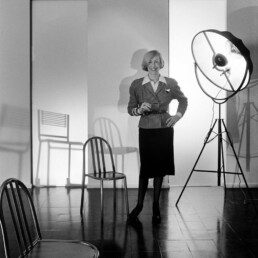
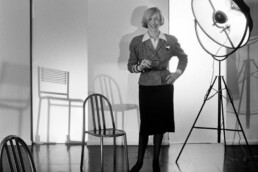
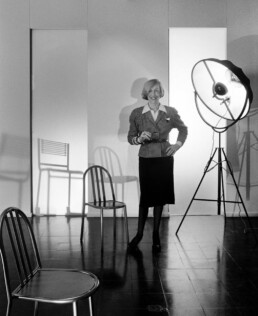
Andrée Putman (1925–2013) created a refined, graphic, and contrasting style, blending classical elegance with radical modernity. With her distinctive and sophisticated presence, she left a lasting impression on her contemporaries, both through her personality and her vision.
Adored in the United States with the Morgans Hotel in New York, she returned to France where she pushed the boundaries of space, pioneering an approach that foreshadowed the “loft” aesthetic. Her apartment in Saint-Germain-des-Prés fully embodied this bold spatial and aesthetic language, which became her signature.
Renowned for her formal precision, she approached interior design as a rigorous composition, both structured and expressive. A pioneer in brand collaborations, she engaged in dialogue with the artists of her time, from Keith Haring to Andy Warhol, and frequented Studio 54 and Le Palace in Paris, epicenters of the creative scene, which she shared with leading figures in fashion and art.
She belonged to that generation of Parisian talents—Mugler, Alaïa, Saint Laurent, Karl Lagerfeld (a close friend)—with whom she shared an uncompromising sense of style. At a time when few traveled internationally, she established herself, like Starck, as one of the first French designers to achieve global recognition.
Her studio trained a generation of designers, all deeply influenced by her rigorous standards. Nicknamed the “high priestess of design,” the “grande dame of design,” or even the “Coco Chanel of design,” her work was celebrated for its clarity and avant-garde modernism — and her name continues to inspire sincere emotion.
Modernism
Archives Designers
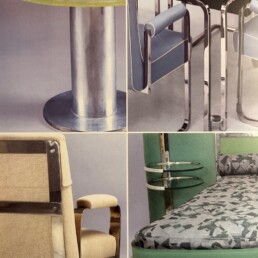
Modernism is a major artistic movement that transformed the entirety of the arts in the 20th century: architecture, painting, sculpture, object design, and the decorative arts. Emerging at the turn of the century and reaching its height around the First World War, it marked a decisive break from academic traditions and historical styles. More than a simple aesthetic language, modernism represents a true cultural and intellectual revolution.
With no strictly defined endpoint, the movement gradually declined between the 1930s and 1950s, giving way in the following decades to the challenges posed by postmodernism. Yet its influence endures, deeply embedded in the evolution of contemporary design and architecture.
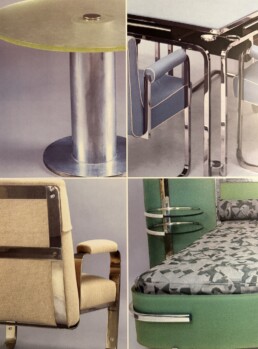
Modernism is characterised by a desire for formal simplicity, structural clarity, and material truth. It rejects superfluous ornament in favour of pure lines, functional volumes, and a rational approach to space. Modern materials — steel, glass, concrete, bent wood — play a central role, celebrated for their intrinsic qualities rather than concealed beneath decorative effects.
Because it is international, the modernist movement draws strength from creators of diverse cultures and sensibilities. Among the major figures are Charlotte Perriand, Isamu Noguchi, Pierre Jeanneret, Sori Yanagi, Alvar Aalto, Gio Ponti, and Pierre Paulin. All share the same ambition: to conceive an art suited to modern life, in which the object is no longer merely decorative but becomes an essential tool of daily living, shaped by technical progress, ergonomics, and humanism.
Today, modernism remains one of the foundational languages of 20th-century design — a timeless vocabulary that continues to inspire architects, designers, and collectors around the world.
Arts & Crafts
Archives Designers
1880 – 1920
The Arts & Crafts Movement emerged in England between the 1860s and 1910, at the heart of the Victorian era. Often considered the British equivalent of French Art Nouveau, it represented a profound break from the rapid industrialisation and mechanical production that dominated society at the time. More than an artistic trend, Arts & Crafts was a true reformist movement, driven by a moral, social, and aesthetic ambition to restore meaning, beauty, and integrity to the act of creation.
Rooted in the ideas of the philosopher and art critic John Ruskin, the movement was championed by his disciple William Morris — a poet, craftsman, designer, and visionary entrepreneur. Together, they defended an approach in which objects should be shaped by the hand of the craftsman, with care, sincerity, and respect for materials. The goal was both artistic and political: to combat the ugliness of industrial production, to restore dignity to manual labour, and to place art back at the centre of daily life.
The Arts & Crafts style is characterised by the use of natural materials — solid oak, mahogany, walnut, leather, copper, blown glass — and by meticulous artisanal techniques such as traditional joinery, ironwork, tapestry, ceramics, and stained glass. Forms remain simple, inspired by nature, stylised floral motifs, or medieval geometries, favouring a discreet, honest, and durable form of beauty.
The movement’s influence was considerable. It inspired early 20th-century design schools, from the Modern Movement to the Bauhaus, and laid the ideological foundations of contemporary architecture and design: respect for materials, the valorisation of craftsmanship, and the belief that every everyday object can — and should — carry meaning.
Pierre Jeanneret
Archives Designers
1896 – 1967
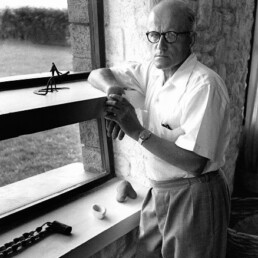
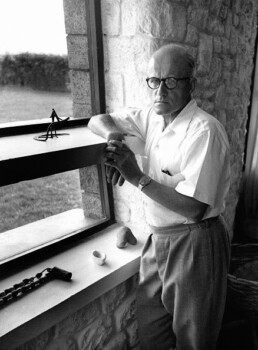
Born in 1896 in Geneva, Pierre Jeanneret graduated from the École des Beaux-Arts in 1921 before settling in Paris, where he became the closest collaborator of his cousin Le Corbusier. Within this exceptional intellectual and creative partnership, Jeanneret found one of the most significant expressions of his talent. In 1926, they jointly authored the manifesto Five Points Towards a New Architecture, a foundational text that broke with methods deemed archaic and established the principles of architectural modernism. Their celebrated Villa Savoye (1929) stands as its most emblematic realisation.
They also created major works such as the Villa Roche (1923), the Swiss Pavilion at the Cité Universitaire in Paris (1931), the project for the Palace of the Soviets in Moscow, and the Salvation Army’s Cité de Refuge (1932). Their architecture, guided by constructive rationality, functional clarity, and the use of refined materials, left a profound mark on the 20th century.
While his collaboration with Le Corbusier greatly contributed to his renown, Jeanneret also developed a remarkable personal body of work, particularly through the creation of modernist furniture. His work in the 1950s for the city of Chandigarh in India represents a defining chapter in his career: there he designed a collection of now-iconic pieces — solid teak armchairs, woven-cane chairs, desks, and bookcases — blending modernist rigour, artisanal construction, and local materials.
Pierre Jeanneret’s furniture, recognisable by its solid wood structures, simple and robust joinery, woven cane, and pure geometric forms, is today highly sought after by collectors and interior designers for its sculptural presence and authenticity.
The legacy of Pierre Jeanneret lies in this dual dimension: an architect who shaped the vision of the Modern Movement, and a designer whose creations, marked by formal simplicity, remain timeless and deeply human.
Josef Hoffmann
Archives Designers
1870 – 1956
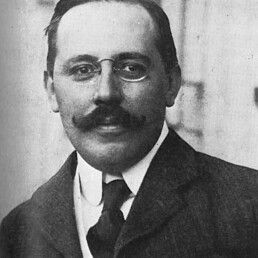
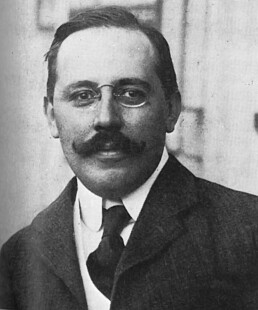
Josef Hoffmann, born on December 15, 1870 in Brtnice, Moravia, and deceased on May 7, 1956 in Vienna, is one of the foremost architects and designers of the Viennese avant-garde. A founding figure of the Vienna Secession alongside Gustav Klimt, he stands among the early pioneers of Art Deco and Modernism, his work heralding the decisive transition from the symbolist ornamentation of the fin-de-siècle to the rigorous aesthetic of modern design.
Hoffmann’s practice is rooted in a constant search for harmony between form, function, and structure, shaped by his attachment to rationalism and geometry. His creations are distinguished by the use of pure lines, orthogonal motifs, repetitive rhythms, and a precision that borders on the architectural. His style, sometimes described as “poetic geometry,” expresses a desire for formal purity and absolute balance.
Hoffmann placed essential importance on noble and artisanal materials: brass, silver, solid wood, as well as fine marquetry, leather, and meticulously crafted textiles. As co-founder of the Wiener Werkstätte in 1903, he advocated for a perfect alliance between art, design, and craftsmanship, bringing together creators and master artisans under a unified ideal.
Among his most emblematic works are the Stoclet House in Brussels — a total masterpiece of late Art Nouveau — the Sitzmaschine chair, the Kubus armchair, the silver boxes and objects of the Wiener Werkstätte, along with geometric lighting and furniture that have become his unmistakable signatures.
His influence is immense: from early modernist design to the emerging Bauhaus, his formal language helped define the aesthetic vocabulary of the entire 20th century.
Jean Prouvé
Archives Designers
1901 – 1984
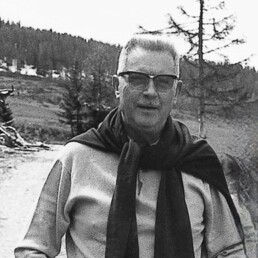
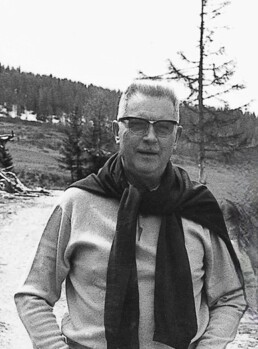
Jean Prouvé, born on April 8, 1901 in the 14th arrondissement of Paris and deceased on March 23, 1984 in Nancy.
Raised within the artistic environment of the École de Nancy, of which his father was a prominent figure, Jean Prouvé — a specialist in metalwork — quickly became part of the Modern Movement. An architect-engineer as well as an authentic creator, he understood, unlike many of his companions in the UAM, that one must “never copy, always create using the most advanced techniques of the moment, but with a complete understanding of the past.”
A builder more attuned to reality than to shifting ideologies, he revolutionised the art of construction through works that extended across all fields of creation, demonstrating rare qualities as both engineer and visual artist. For him, “there is no difference between constructing a piece of furniture and constructing a house.” The same rigour must apply.
The furniture he produced in his Maxéville workshops ranks among the most remarkable French pieces of the 1950s. Although initially disconcerting, their charm quickly asserts itself through exceptional detailing and unparalleled craftsmanship.
His Grand Prix national de l’architecture in 1982, along with his many collaborations with some of the most important architects of his time, make Jean Prouvé one of the most prestigious figures of modern art and design.
Patrick Favardin, Le Style 50 — Un moment de l’art français, Éditions Sous Le Vent, Paris, 1987.
Henry Jacques Le Même
Archives Designers
1897 – 1997
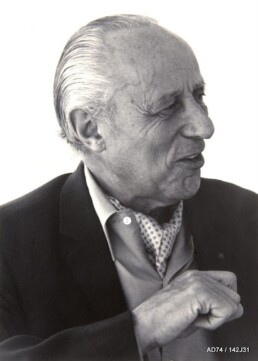
Considered one of the inventors of modern Alpine architecture, Henry Jacques Le Même (1897–1997) settled in Megève in 1925, after spending two years in the Paris studio of Jacques-Émile Ruhlmann.
His first chalet, designed for Baroness Noémie de Rothschild, set the tone for a new aesthetic that combined Savoyard tradition with modern comfort. Sheltered beneath vast roofs, his chalets capture the light. Their simplicity is highlighted by touches of vivid colour on shutters, windows, doors, and the ends of wooden beams. Inside, spacious living rooms open onto the valley and extend into enveloping balconies.
For his own house, built between 1920 and 1930, Henry Jacques Le Même broke his own rules, introducing a roof terrace and red ochre façades. This building, which reveals a creative tension born from the desire to innovate in the face of the mountain’s immutable power, was paradoxically perceived less as a manifesto of modernity than as an exotic note among the forest of chalets — much like a Chinese pagoda or Moorish casino would once punctuate the uniformity of a 19th-century neighbourhood.
Architectures de Henry Jacques Le Même, Institut Français d’Architecture, Éditions Norma, 1999.
Gio Ponti
Archives Designers
1891 – 1979
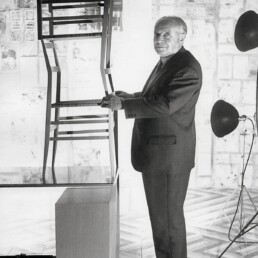
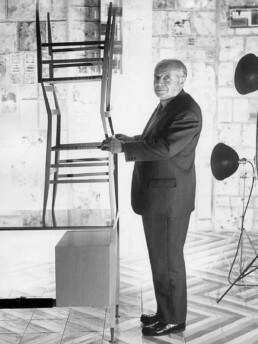
Gio Ponti (1891–1979), born and deceased in Milan, is one of the major figures of Italian architecture and design. A key actor in post-war architecture, he profoundly renewed the notion of modern living and paved the way for a new art of living that blended elegance, lightness, and innovation. An exceptionally prolific creator, he constantly positioned himself at the crossroads between industry and craftsmanship, convinced that design should reconcile beauty, function, and accessibility.
His approach was rooted in a search for architectural lightness, elongated lines, and harmonious proportions. Ponti favoured open, modular forms and the idea of joyful, luminous architecture designed to enhance everyday life. His design practice expresses a constant balance between modernist rationality and poetic sensitivity, between geometric rigour and Mediterranean softness.
Ponti worked with a wide range of refined materials: bentwood, ash, mahogany, glazed ceramics, brass, glass, and printed textiles. A passionate craftsman, he founded Domus magazine in 1928, profoundly shaping design culture, and collaborated with leading Italian manufacturers such as Cassina, Fontana Arte, and Ginori 1735.
Among his most iconic creations are the Superleggera (1957), a masterpiece of conceptual lightness; the Pirelli Tower (1956) in Milan; furniture and lighting for Fontana Arte; ceramics for Richard-Ginori; as well as the legendary interiors of the Ponti House and the Parco dei Principi hotels.
Considered one of the absolute masters of Italian architecture, Gio Ponti left behind a visionary, vibrant, and profoundly modern legacy — an influence that continues to shape contemporary design today.
Georges Jouve
Archives Designers
Born 1910
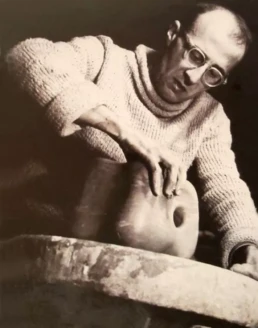
At the École Boulle, Georges Jouve discovered the demanding techniques of the decorative arts. At the Académie de la Grande Chaumière and the Académie Julian, he found the freedom and means to develop his own artistic personality. Then war broke out. Taken prisoner in a camp, Jouve drew men with outstretched hands and signed his works “Apollon.”
Later, as a refugee in Dieulefit with his wife Jacqueline, he rediscovered life, the magic of working with clay, and became a potter. This was the beginning of his artistic journey.
After the war, back in Paris, he took part fully in the great creative momentum of the time, which brought together very different personalities united by mutual respect and friendship. On Rue de la Tombe-Issoire, he hosted Pouchol, Deswane, Arbus, Adnet… Each day he further perfected his art—an art deliberately humanised, “in which every fragment asserts reason, organises space,” and where humour mingles with gentleness. His exacting nature, even harsh at times toward his students, reflected the demands required for true artistic accomplishment.
Jouve’s reputation was considerable; both his compelling personality and his mastery of his craft left a deep impression. In March 1964, illness brought his journey to an end. But his ceramics forever carry the traces of his explorations, his struggles, and his joys—those of an artist who so fully embodied the creative spirit of the Style 50 movement.
Patrick Favardin, Le Style 50 — Un moment de l’art français, Éditions Sous Le Vent, Paris, 1987.
Ettore Sottsass
Archives Designers
1917 – 2007
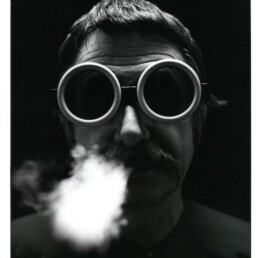
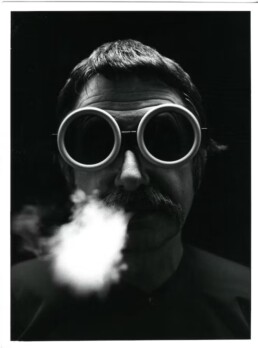
Ettore Sottsass (1917–2007) was an Italian architect and designer, regarded as one of the most influential figures in 20th-century design. His work spanned several movements, from modern architecture to postmodernism, and he is best known as one of the founders of the Memphis Group — a revolutionary collective established in 1981 that redefined contemporary design through its bold, colourful, and non-conformist approach.
Beyond Memphis, Sottsass’s practice was rooted in a deeply humanistic vision of design: creating objects capable of eliciting emotion and questioning the relationship between human beings, space, and colour. He rejected the coldness of functionalism in favour of an expressive, symbolic and at times spiritual aesthetic. His signature is recognisable in the use of simple yet powerful architectural forms, pronounced contrasts, and a visual language that borders on art and ritual.
Materials play a central role in his work: the now-iconic coloured laminate, lacquered woods, sculptural ceramics, blown glass, as well as industrial materials repurposed or hybridised. His creations oscillate between Mediterranean craftsmanship, avant-garde experimentation, and primitive or pop references.
Among his most emblematic pieces are the Valentine typewriter (1969) for Olivetti, the Carlton bookcase (1981) — a true manifesto of Memphis postmodernism — as well as the Yantra ceramics and the ceramic totems produced in the 1960s and 1970s. His collaborations with Olivetti, Kartell, Bitossi, and Poltronova also yielded works that have become icons of contemporary design.
Today, Ettore Sottsass is celebrated as a visionary creator whose legacy continues to influence architecture, design, and visual culture in the 21st century.