Charlotte Perriand
Archives Designers
1903 – 1999
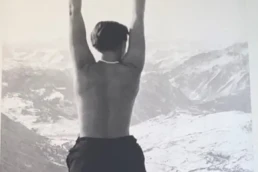
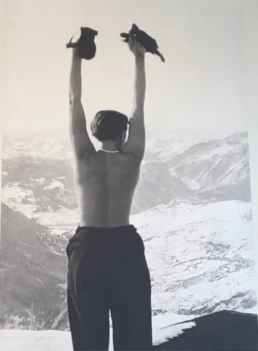
Born in 1903, Charlotte Perriand was admitted to the École de l’Union Centrale des Arts Décoratifs in 1920. After taking part in the 1925 Exposition and the 1926 Salon des Arts Décoratifs, she broke entirely with conventional aesthetics the following year by presenting her “Bar sous le toit” — a rooftop bar—made of chromed steel and anodised aluminium. The success was immediate, and her path became clear: she joined the studio of Le Corbusier and Pierre Jeanneret.
From this point on, her career became inseparable from the Modern Movement, and in 1929 she played an active role in founding the Union des Artistes Modernes. Less formalist than the members of the Bauhaus, she brought a more human dimension to her designs through her fluid use of materials and her incorporation of stone blocks, pebbles, or tree branches, whose beauty, to her, embodied an organic as much as a functional truth.
A mission in Japan allowed her to test and expand her ideas: connection with nature, standardisation of components, integration of built-in elements, and furniture reduced to the essential. Trained in the modern school, enriched by a privileged relationship with nature, and confirmed in her convictions by her time in Japan, Charlotte Perriand developed after the war a style that is pure, powerful, and profoundly humanist.
Patrick Favardin, Le Style 50 — Un moment de l’art français, Éditions Sous Le Vent, Paris, 1987.
Texts by Guillemette Delaporte and Gérard Xuriguera.
Carlo Scarpa
Archives Designers
1926 — 1995
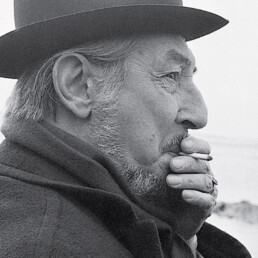
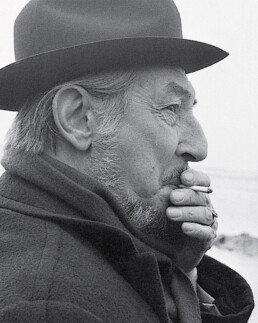
Carlo Scarpa, born in Venice in 1906 and deceased in Sendai, Japan, in 1978, is one of the most sensitive and poetic Italian architects and designers of the 20th century. His work is deeply influenced by materials, landscape, and the history and traditions of both Venetian and Japanese culture. A master of detail and assembly, Scarpa developed a unique architectural language blending modernity and memory, constructive precision and artisanal sensitivity.
His approach was grounded in a meticulous exploration of materials — stone, concrete, glass, wood, bronze — which he worked with the same care as an artisan and as an architect. He considered every joint, every edge, every variation in thickness as a meaningful gesture. Japan, which he discovered late but intensely, further strengthened his fascination with the art of detail, silent proportions, and subtle transitions between surfaces and light.
Scarpa was also a renowned designer of glassware and furniture. His collaborations with Venini in the 1930s and 1940s established him as one of the most refined creators of Venetian glassmaking: vases with complex textures, modulated transparencies, and reinterpreted murrine and battuto techniques executed with near-sculptural precision.
In furniture, he favoured exposed joinery, meticulous metal fittings, and noble materials such as walnut, teak, and brass.
His iconic works include the Castelvecchio Museum in Verona — a masterpiece of contemporary restoration; the Brion Tomb in San Vito d’Altivole, a spiritual manifesto where architecture, water, and landscape merge; the Fondazione Querini Stampalia in Venice; as well as his glass designs for Venini, now highly sought after by collectors.
Carlo Scarpa leaves behind a rare legacy: a design where the art of detail meets the depth of gesture, and where the passage of time becomes a material of architecture itself.