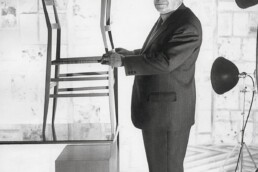
Gio Ponti
1891 – 1979
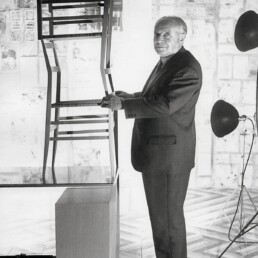
Gio Ponti (1891–1979), born and deceased in Milan, is one of the major figures of Italian architecture and design. A key actor in post-war architecture, he profoundly renewed the notion of modern living and paved the way for a new art of living that blended elegance, lightness, and innovation. An exceptionally prolific creator, he constantly positioned himself at the crossroads between industry and craftsmanship, convinced that design should reconcile beauty, function, and accessibility.
His approach was rooted in a search for architectural lightness, elongated lines, and harmonious proportions. Ponti favoured open, modular forms and the idea of joyful, luminous architecture designed to enhance everyday life. His design practice expresses a constant balance between modernist rationality and poetic sensitivity, between geometric rigour and Mediterranean softness.
Ponti worked with a wide range of refined materials: bentwood, ash, mahogany, glazed ceramics, brass, glass, and printed textiles. A passionate craftsman, he founded Domus magazine in 1928, profoundly shaping design culture, and collaborated with leading Italian manufacturers such as Cassina, Fontana Arte, and Ginori 1735.
Among his most iconic creations are the Superleggera (1957), a masterpiece of conceptual lightness; the Pirelli Tower (1956) in Milan; furniture and lighting for Fontana Arte; ceramics for Richard-Ginori; as well as the legendary interiors of the Ponti House and the Parco dei Principi hotels.
Considered one of the absolute masters of Italian architecture, Gio Ponti left behind a visionary, vibrant, and profoundly modern legacy — an influence that continues to shape contemporary design today.