Georges Jouve
Born 1910
At the École Boulle, Georges Jouve discovered the demanding techniques of the decorative arts. At the Académie de la Grande Chaumière and the Académie Julian, he found the freedom and means to develop his own artistic personality. Then war broke out. Taken prisoner in a camp, Jouve drew men with outstretched hands and signed his works “Apollon.”
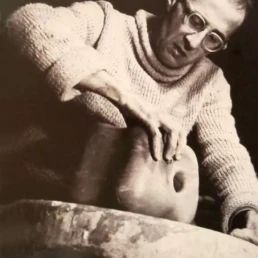
Later, as a refugee in Dieulefit with his wife Jacqueline, he rediscovered life, the magic of working with clay, and became a potter. This was the beginning of his artistic journey.
After the war, back in Paris, he took part fully in the great creative momentum of the time, which brought together very different personalities united by mutual respect and friendship. On Rue de la Tombe-Issoire, he hosted Pouchol, Deswane, Arbus, Adnet… Each day he further perfected his art—an art deliberately humanised, “in which every fragment asserts reason, organises space,” and where humour mingles with gentleness. His exacting nature, even harsh at times toward his students, reflected the demands required for true artistic accomplishment.
Jouve’s reputation was considerable; both his compelling personality and his mastery of his craft left a deep impression. In March 1964, illness brought his journey to an end. But his ceramics forever carry the traces of his explorations, his struggles, and his joys—those of an artist who so fully embodied the creative spirit of the Style 50 movement.
Patrick Favardin, Le Style 50 — Un moment de l’art français, Éditions Sous Le Vent, Paris, 1987.