Carlo Scarpa
1926 — 1995
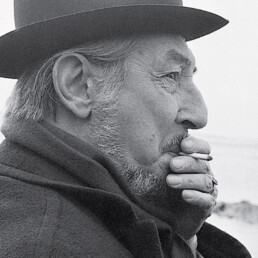
Carlo Scarpa, born in Venice in 1906 and deceased in Sendai, Japan, in 1978, is one of the most sensitive and poetic Italian architects and designers of the 20th century. His work is deeply influenced by materials, landscape, and the history and traditions of both Venetian and Japanese culture. A master of detail and assembly, Scarpa developed a unique architectural language blending modernity and memory, constructive precision and artisanal sensitivity.
His approach was grounded in a meticulous exploration of materials — stone, concrete, glass, wood, bronze — which he worked with the same care as an artisan and as an architect. He considered every joint, every edge, every variation in thickness as a meaningful gesture. Japan, which he discovered late but intensely, further strengthened his fascination with the art of detail, silent proportions, and subtle transitions between surfaces and light.
Scarpa was also a renowned designer of glassware and furniture. His collaborations with Venini in the 1930s and 1940s established him as one of the most refined creators of Venetian glassmaking: vases with complex textures, modulated transparencies, and reinterpreted murrine and battuto techniques executed with near-sculptural precision.
In furniture, he favoured exposed joinery, meticulous metal fittings, and noble materials such as walnut, teak, and brass.
His iconic works include the Castelvecchio Museum in Verona — a masterpiece of contemporary restoration; the Brion Tomb in San Vito d’Altivole, a spiritual manifesto where architecture, water, and landscape merge; the Fondazione Querini Stampalia in Venice; as well as his glass designs for Venini, now highly sought after by collectors.
Carlo Scarpa leaves behind a rare legacy: a design where the art of detail meets the depth of gesture, and where the passage of time becomes a material of architecture itself.