Arts & Crafts
1880 – 1920
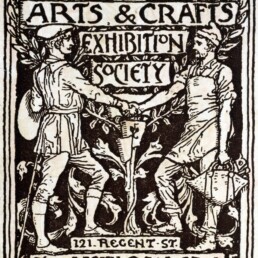
The Arts & Crafts Movement emerged in England between the 1860s and 1910, at the heart of the Victorian era. Often considered the British equivalent of French Art Nouveau, it represented a profound break from the rapid industrialisation and mechanical production that dominated society at the time. More than an artistic trend, Arts & Crafts was a true reformist movement, driven by a moral, social, and aesthetic ambition to restore meaning, beauty, and integrity to the act of creation.
Rooted in the ideas of the philosopher and art critic John Ruskin, the movement was championed by his disciple William Morris — a poet, craftsman, designer, and visionary entrepreneur. Together, they defended an approach in which objects should be shaped by the hand of the craftsman, with care, sincerity, and respect for materials. The goal was both artistic and political: to combat the ugliness of industrial production, to restore dignity to manual labour, and to place art back at the centre of daily life.
The Arts & Crafts style is characterised by the use of natural materials — solid oak, mahogany, walnut, leather, copper, blown glass — and by meticulous artisanal techniques such as traditional joinery, ironwork, tapestry, ceramics, and stained glass. Forms remain simple, inspired by nature, stylised floral motifs, or medieval geometries, favouring a discreet, honest, and durable form of beauty.
The movement’s influence was considerable. It inspired early 20th-century design schools, from the Modern Movement to the Bauhaus, and laid the ideological foundations of contemporary architecture and design: respect for materials, the valorisation of craftsmanship, and the belief that every everyday object can — and should — carry meaning.