Pierre Jeanneret
1896 – 1967
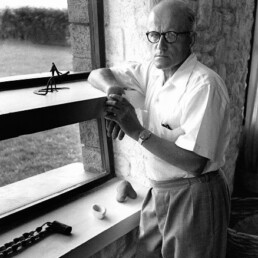
Born in 1896 in Geneva, Pierre Jeanneret graduated from the École des Beaux-Arts in 1921 before settling in Paris, where he became the closest collaborator of his cousin Le Corbusier. Within this exceptional intellectual and creative partnership, Jeanneret found one of the most significant expressions of his talent. In 1926, they jointly authored the manifesto Five Points Towards a New Architecture, a foundational text that broke with methods deemed archaic and established the principles of architectural modernism. Their celebrated Villa Savoye (1929) stands as its most emblematic realisation.
They also created major works such as the Villa Roche (1923), the Swiss Pavilion at the Cité Universitaire in Paris (1931), the project for the Palace of the Soviets in Moscow, and the Salvation Army’s Cité de Refuge (1932). Their architecture, guided by constructive rationality, functional clarity, and the use of refined materials, left a profound mark on the 20th century.
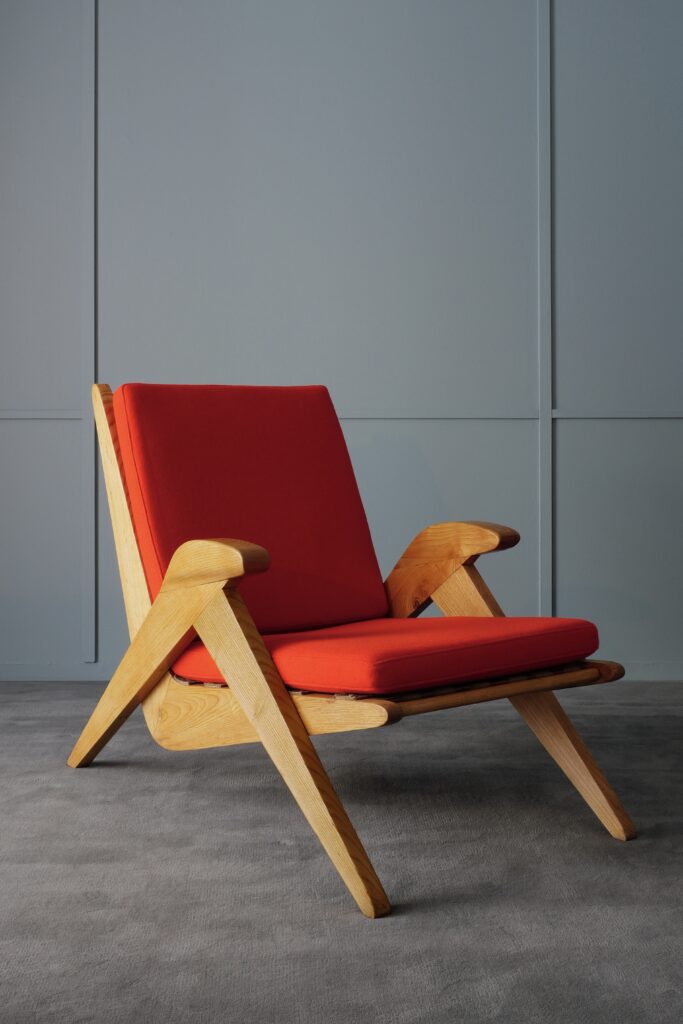
While his collaboration with Le Corbusier greatly contributed to his renown, Jeanneret also developed a remarkable personal body of work, particularly through the creation of modernist furniture. His work in the 1950s for the city of Chandigarh in India represents a defining chapter in his career: there he designed a collection of now-iconic pieces — solid teak armchairs, woven-cane chairs, desks, and bookcases — blending modernist rigour, artisanal construction, and local materials.
Pierre Jeanneret’s furniture, recognisable by its solid wood structures, simple and robust joinery, woven cane, and pure geometric forms, is today highly sought after by collectors and interior designers for its sculptural presence and authenticity.
The legacy of Pierre Jeanneret lies in this dual dimension: an architect who shaped the vision of the Modern Movement, and a designer whose creations, marked by formal simplicity, remain timeless and deeply human.