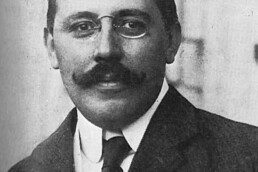
Josef Hoffmann
1870 – 1956
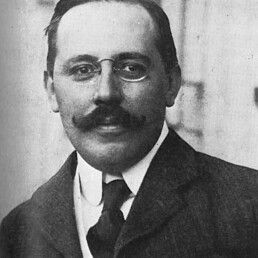
Josef Hoffmann, born on December 15, 1870 in Brtnice, Moravia, and deceased on May 7, 1956 in Vienna, is one of the foremost architects and designers of the Viennese avant-garde. A founding figure of the Vienna Secession alongside Gustav Klimt, he stands among the early pioneers of Art Deco and Modernism, his work heralding the decisive transition from the symbolist ornamentation of the fin-de-siècle to the rigorous aesthetic of modern design.
Hoffmann’s practice is rooted in a constant search for harmony between form, function, and structure, shaped by his attachment to rationalism and geometry. His creations are distinguished by the use of pure lines, orthogonal motifs, repetitive rhythms, and a precision that borders on the architectural. His style, sometimes described as “poetic geometry,” expresses a desire for formal purity and absolute balance.
Hoffmann placed essential importance on noble and artisanal materials: brass, silver, solid wood, as well as fine marquetry, leather, and meticulously crafted textiles. As co-founder of the Wiener Werkstätte in 1903, he advocated for a perfect alliance between art, design, and craftsmanship, bringing together creators and master artisans under a unified ideal.
Among his most emblematic works are the Stoclet House in Brussels — a total masterpiece of late Art Nouveau — the Sitzmaschine chair, the Kubus armchair, the silver boxes and objects of the Wiener Werkstätte, along with geometric lighting and furniture that have become his unmistakable signatures.
His influence is immense: from early modernist design to the emerging Bauhaus, his formal language helped define the aesthetic vocabulary of the entire 20th century.