Ettore Sottsass
1917 – 2007
Ettore Sottsass (1917–2007) was an Italian architect and designer, regarded as one of the most influential figures in 20th-century design. His work spanned several movements, from modern architecture to postmodernism, and he is best known as one of the founders of the Memphis Group — a revolutionary collective established in 1981 that redefined contemporary design through its bold, colourful, and non-conformist approach.
Beyond Memphis, Sottsass’s practice was rooted in a deeply humanistic vision of design: creating objects capable of eliciting emotion and questioning the relationship between human beings, space, and colour. He rejected the coldness of functionalism in favour of an expressive, symbolic and at times spiritual aesthetic. His signature is recognisable in the use of simple yet powerful architectural forms, pronounced contrasts, and a visual language that borders on art and ritual.
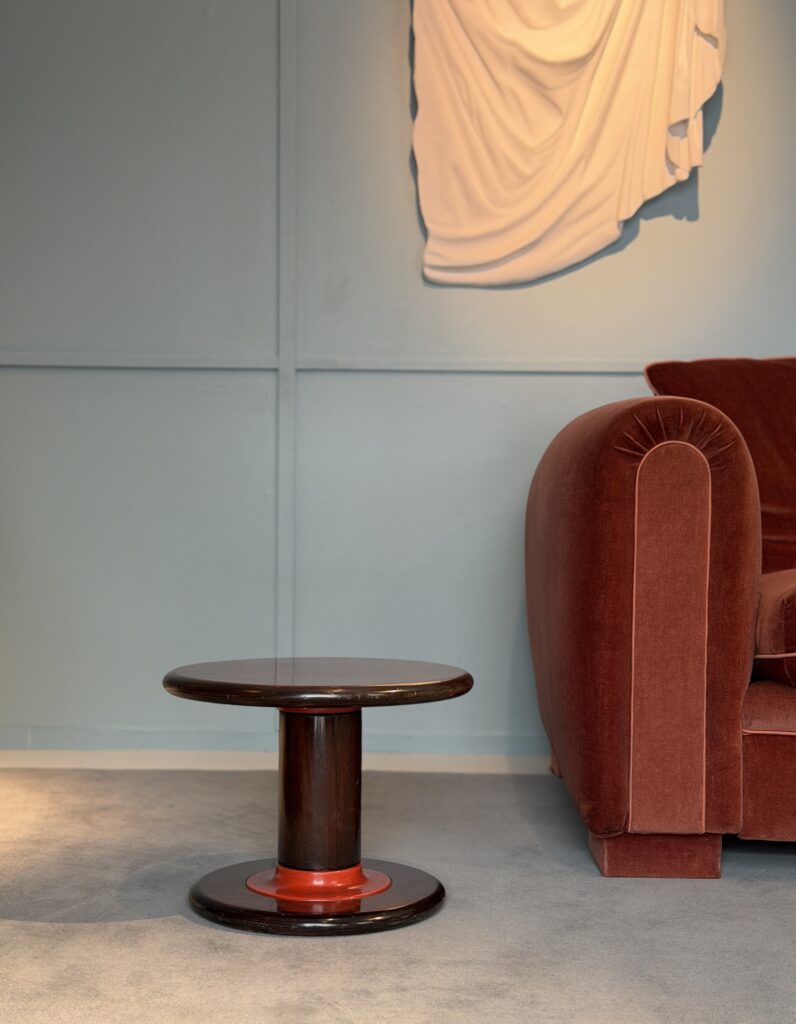
Materials play a central role in his work: the now-iconic coloured laminate, lacquered woods, sculptural ceramics, blown glass, as well as industrial materials repurposed or hybridised. His creations oscillate between Mediterranean craftsmanship, avant-garde experimentation, and primitive or pop references.
Among his most emblematic pieces are the Valentine typewriter (1969) for Olivetti, the Carlton bookcase (1981) — a true manifesto of Memphis postmodernism — as well as the Yantra ceramics and the ceramic totems produced in the 1960s and 1970s. His collaborations with Olivetti, Kartell, Bitossi, and Poltronova also yielded works that have become icons of contemporary design.
Today, Ettore Sottsass is celebrated as a visionary creator whose legacy continues to influence architecture, design, and visual culture in the 21st century.